
Written and medically reviewed by Dr Sudeep, Consultant Urologist and Andrologist. Last updated: 16 November 2026.
What was done?
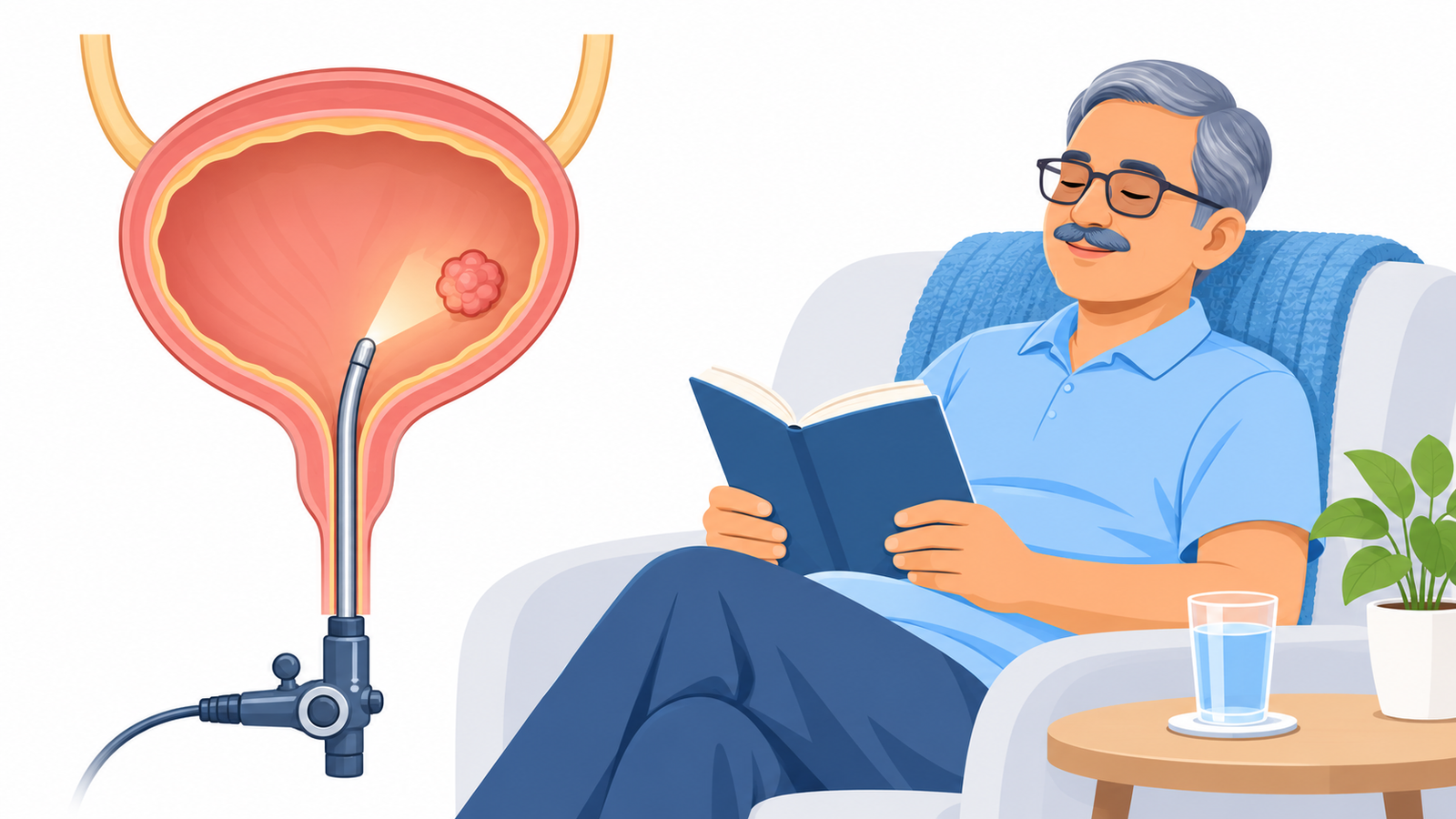
Recovery after bladder tumour surgery is usually quick. TURBT (transurethral resection of bladder tumour) removes a growth from the inside of the bladder using a thin telescope passed through the urine passage. There are no cuts on the skin. The tissue removed is sent to the laboratory to find out exactly what type of growth it is and how deep it goes.
In hospital
- You will usually have a urinary catheter for about 3 to 5 days, sometimes with a saline wash to clear blood.
- Many patients receive a single dose of a medicine (chemotherapy) put directly into the bladder through the catheter within a few hours of surgery. This lowers the chance of the tumour coming back. It is held in the bladder for about an hour and then drained.
- Once your urine is clear enough and the catheter is out, you can usually go home.
The first few weeks at home: what is normal
- Blood in urine: Pink urine or small clots are common for 1 to 2 weeks. Bleeding can come back around 10 to 14 days after surgery, when scabs fall off.
- Burning and frequency: Stinging and needing to pass urine often usually settle within 1 to 2 weeks.
- Mild lower tummy discomfort: Usually eased by simple painkillers.
Tips for recovery after bladder tumour surgery
- Drink well: About 2 to 3 litres a day for the first 2 weeks, unless your doctor has advised otherwise. Your urine should be pale.
- Avoid constipation: Eat fibre-rich food and avoid straining on the toilet.
- Activity: Walk every day. Avoid heavy lifting, gym work and strenuous activity for about 2 to 3 weeks.
- Work and driving: Most people return to desk work and driving within 1 to 2 weeks.
- Medicines: Restart blood thinners only when your doctor says so.
- Stop smoking: Smoking is the biggest risk factor for bladder cancer. Stopping lowers the chance of it coming back. Ask us for help to quit.
Your biopsy results
Your results usually take about 1 to 2 weeks. Your doctor will explain them at your follow-up visit. Depending on the result, you may need:
- Regular check cystoscopies (a camera test of the bladder) only
- A course of medicine put into the bladder, such as BCG or chemotherapy, given weekly for a few weeks
- A second TURBT, usually within about 6 weeks, to make sure nothing was left behind
- Further scans or a different treatment if the tumour is deeper
Why follow-up matters
Bladder tumours can come back, even after successful surgery. Regular check cystoscopies catch any new growth early, when it is easiest to treat. Please do not miss your appointments, even if you feel completely well.
Contact your doctor urgently if you have
- Thick red urine or clots that do not clear with extra fluids
- You cannot pass urine, or your lower tummy feels full and painful
- Fever, chills or shivering
- Severe pain not helped by painkillers
- Calf pain or swelling, chest pain or breathlessness
Common questions
Does a bladder tumour always mean cancer? Most bladder tumours are cancers, but the majority are found early and do not spread into the bladder wall. These are very treatable.
Will it come back? It can, which is why regular check-ups are so important.
Can I have sex after TURBT? Usually after about 2 weeks, once bleeding has settled. If you are having medicine put into the bladder, your doctor will advise on using condoms.
For more information, see the European Association of Urology guide on TURBT.
This guide is for general education and does not replace advice from your own doctor.