
An enlarged prostate is very common in men as they get older. Doctors call it benign prostatic hyperplasia, or BPH. “Benign” means it is not cancer. An enlarged prostate can make passing urine slow, frequent or difficult, but many good treatments are available. This guide explains the symptoms, causes, tests and treatment options in simple language.
Table of Contents
What is the prostate?
The prostate is a small gland, about the size of a walnut, found only in men. It sits just below the bladder and wraps around the urethra, the tube that carries urine out of the body. The prostate makes part of the fluid in semen.
What is an enlarged prostate (BPH)?
With age, the prostate slowly grows larger. As it grows, it can press on the urethra and make it harder for urine to flow out of the bladder. BPH is very common: around half of men in their 60s, and most men over 80, have some degree of enlargement.
The size of the prostate does not always match the symptoms. Some men with a large prostate have few problems, while others with a smaller prostate have troublesome symptoms.
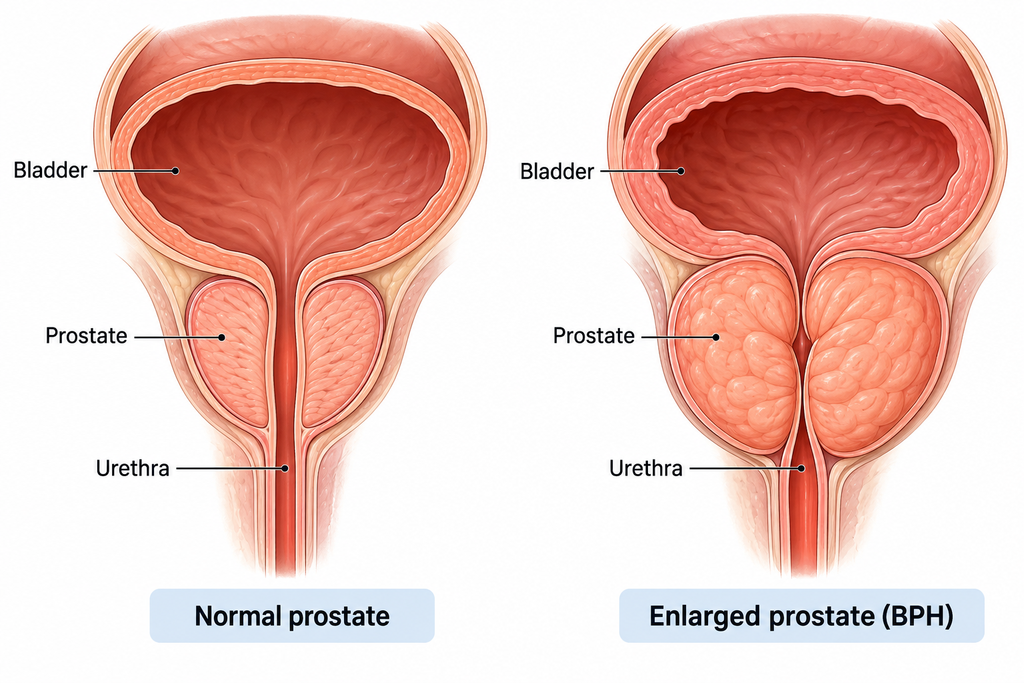
Symptoms of an enlarged prostate
Symptoms can be grouped into two types.
Problems with emptying the bladder:
- Weak or slow urine stream
- Difficulty starting to pass urine
- Straining to pass urine
- Stream that stops and starts
- Dribbling at the end
- Feeling that the bladder is not completely empty
Problems with storing urine:
- Passing urine often during the day
- Waking up at night to pass urine (nocturia)
- A sudden, strong urge to pass urine
- Sometimes leaking urine before reaching the toilet
When is an enlarged prostate an emergency?
Go to the emergency department straight away if you:
- Cannot pass urine at all, especially with lower tummy pain (acute urinary retention)
- Have fever with burning or pain while passing urine
- See heavy blood or clots in the urine
What causes an enlarged prostate?
The exact cause is not fully understood. The main factors are:
- Age: the risk rises steadily after 40 to 50 years.
- Hormones: changes in male hormones with age play a key role.
- Family history: BPH can run in families.
- Lifestyle factors: obesity, diabetes, high blood pressure and low physical activity are linked to more symptoms.
Is an enlarged prostate the same as prostate cancer?
No. BPH is not cancer and does not turn into cancer. However, both conditions are common in older men and can occur together, and early prostate cancer often causes no symptoms. That is why your urologist may advise a PSA blood test and a prostate examination.
How is an enlarged prostate diagnosed?
Your urologist may arrange some of the following:
- Symptom score (IPSS): a short questionnaire that measures how much your symptoms bother you.
- Physical examination, including a gentle examination of the prostate through the back passage (digital rectal examination).
- Urine test to check for infection or blood.
- PSA blood test, after discussing its benefits and limits with you.
- Kidney function blood test.
- Ultrasound to check the prostate size and how much urine remains in the bladder after passing urine.
- Uroflowmetry, a simple test where you pass urine into a machine that measures the strength of the flow.
- Bladder diary, recording how often and how much you pass urine, especially if you wake often at night.
Treatment options for an enlarged prostate
Treatment depends on how much the symptoms bother you, the size of your prostate, and whether there are any complications. Not everyone needs treatment.
Watchful waiting and lifestyle changes
If symptoms are mild, simple changes may be enough:
- Reduce fluids in the 2 hours before bedtime
- Cut down on tea, coffee and alcohol, especially in the evening
- Avoid constipation
- Take time to empty the bladder fully, and try passing urine again after a short pause (double voiding)
- Review medicines that can worsen symptoms, such as some cold medicines
Medicines for an enlarged prostate
- Alpha blockers (such as tamsulosin, silodosin or alfuzosin) relax the muscle of the prostate and bladder neck. They work within days. Possible side effects include dizziness on standing and reduced or absent semen at ejaculation.
- 5-alpha reductase inhibitors (finasteride or dutasteride) slowly shrink the prostate. They take 3 to 6 months to work and are useful for larger prostates. They lower the PSA level by about half, so your doctor will take this into account. Some men notice reduced sex drive or erection problems.
- Combination treatment of both types is often used for larger prostates with more troublesome symptoms.
- Tadalafil, a medicine also used for erection problems, can improve urinary symptoms in some men.
- Bladder-calming medicines may be added if urgency and frequency are the main problems.
Always take these medicines only on a doctor’s advice.
Surgery and minimally invasive procedures
Surgery or a procedure is usually advised when:
- Medicines are not working well or cause side effects
- You have had urinary retention (unable to pass urine)
- You have repeated urine infections, bladder stones or bleeding from the prostate
- The kidneys are being affected by the blockage
- You prefer a lasting solution rather than lifelong medicines
The main options include:
- TURP (transurethral resection of the prostate): the standard operation for many years. Excess prostate tissue is removed through the urine passage, with no cut on the body.
- HoLEP (holmium laser enucleation of the prostate): a laser is used to remove the blocking prostate tissue through the urine passage. It suits prostates of almost any size, including very large ones.
- UroLift: small implants hold the enlarged prostate lobes apart, opening the channel. It is quick and tends to preserve ejaculation, but it suits only selected prostate sizes and shapes.
- Rezum (water vapour therapy): steam is used to shrink prostate tissue. It is done through the urine passage and also tends to preserve ejaculation. Improvement builds up over a few weeks.
- Simple prostatectomy: for very large prostates, by open or robotic surgery, in selected cases.
Your urologist will explain which option suits your prostate size, symptoms, health and priorities, such as preserving ejaculation.
Complications of an untreated enlarged prostate
Most men with BPH never develop serious problems. In some, a long-standing blockage can lead to:
- Sudden inability to pass urine (acute urinary retention)
- Repeated urine infections
- Bladder stones
- Blood in the urine
- A weakened, overstretched bladder
- Rarely, damage to the kidneys
Frequently asked questions
Can an enlarged prostate be cured with medicine?
Medicines can control symptoms very well, and some shrink the prostate, but they need to be taken long term. Surgery or a procedure gives a more lasting solution when it is needed.
Does an enlarged prostate cause cancer?
No. BPH does not cause prostate cancer, but both can happen at the same time, so check-ups and, where appropriate, a PSA test are important.
At what age does the prostate start to enlarge?
Prostate growth usually starts after the age of 40, and symptoms become more common after 50.
Will prostate surgery affect my sex life?
Erections are usually not affected. After TURP or HoLEP, many men have “dry” ejaculation, where semen goes back into the bladder. This is not harmful. UroLift and Rezum usually preserve ejaculation.
Which doctor should I see for an enlarged prostate?
A urologist is the specialist who treats prostate problems.
This article is based on the European Association of Urology (EAU) Guidelines on Management of Non-neurogenic Male LUTS.