
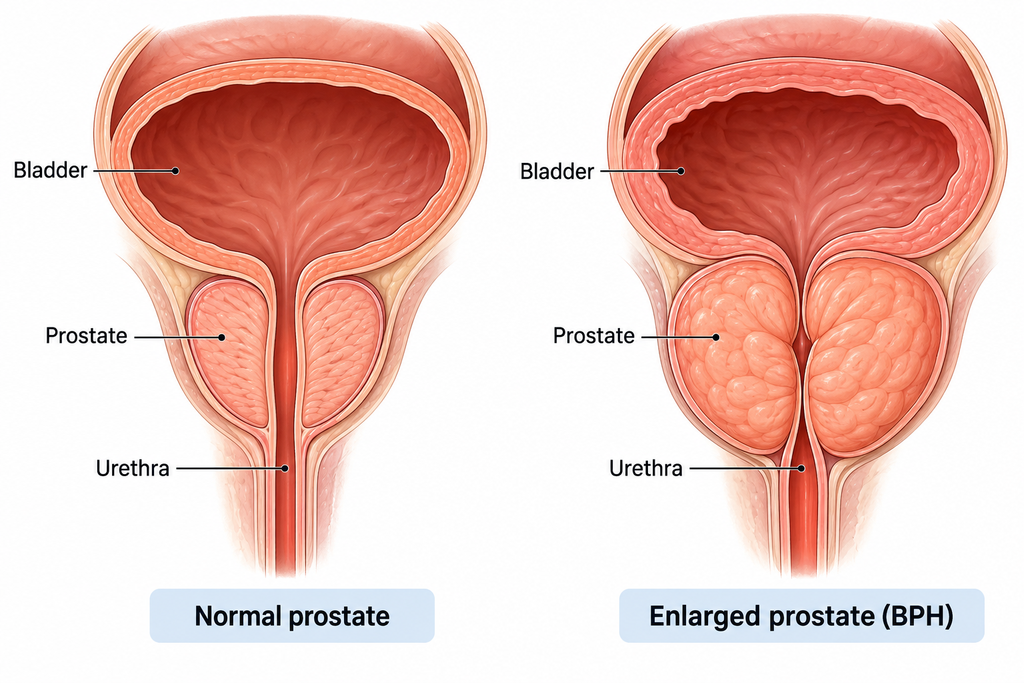
BPH myths are one of the main reasons men delay seeing a doctor. “It’s just age.” “It will turn into cancer.” “Surgery will ruin everything.” An enlarged prostate, called benign prostatic hyperplasia (BPH), is very common and very treatable. Here we separate common BPH myths from the facts.
Table of Contents
7 common BPH myths and the facts
Myth 1: An enlarged prostate always turns into prostate cancer
Fact: BPH is a benign, non-cancerous condition, and it does not turn into cancer. However, BPH and prostate cancer are both common in older men and can occur together. That is why your doctor may check for both separately.
Myth 2: Only very old men get BPH
Fact: Symptoms can start in the 40s. BPH becomes much more common after 50 and keeps increasing with age.
Myth 3: Prostate surgery always ruins your sex life
Fact: Erections are usually not affected by modern prostate procedures. After TURP or HoLEP, many men have “dry” ejaculation, where semen goes back into the bladder instead of coming out. This is not harmful, but it does affect fertility. Some newer procedures, such as UroLift and Rezum, usually preserve ejaculation. Discuss your priorities with your urologist before choosing a treatment.
Myth 4: Waking up at night to pass urine is just normal ageing
Fact: Waking at night to pass urine (nocturia) is common, but it is not something you simply have to live with. It can have several causes, including BPH, drinking late in the evening, diabetes, sleep problems and some medicines. Most causes can be treated once they are properly assessed.
Myth 5: Herbal supplements can shrink an enlarged prostate
Fact: Supplements such as saw palmetto are widely sold, but good-quality studies have not shown that they shrink the prostate or improve symptoms better than a dummy pill. Proper medical assessment is the safer route.
Myth 6: If passing urine feels fine, you never need a prostate check
Fact: Early prostate cancer often causes no symptoms. Men aged 50 and above, or 45 and above with a family history of prostate cancer, may be offered a PSA blood test. It has benefits and limits, so it is best decided after discussing them with your doctor.
Myth 7: BPH medicines work immediately
Fact: Alpha blockers, such as tamsulosin, can ease symptoms within days. Medicines that shrink the prostate, such as finasteride or dutasteride, take 3 to 6 months to show their full effect.
Questions men often ask about BPH
How is BPH different from prostate cancer?
BPH is a benign enlargement that causes urinary symptoms. Prostate cancer is a malignant growth that may cause no symptoms in its early stages. A PSA blood test and examination help assess the prostate, but only a biopsy can confirm cancer.
Is surgery always needed for BPH?
No. Many men do well with lifestyle changes and medicines. Surgery or a minimally invasive procedure is considered when symptoms are troublesome despite medicines, or when complications such as urinary retention, repeated infections, bladder stones or kidney problems develop.
Can an enlarged prostate damage the kidneys?
Rarely. If a blockage is left untreated for a long time, urine can back up and put pressure on the kidneys. This is one reason not to ignore persistent symptoms.
How soon can I return to normal routine after BPH surgery?
Most men go home within 1 to 2 days and return to light daily activities within 1 to 2 weeks. Heavy lifting and strenuous exercise are usually avoided for about 4 weeks.
Does BPH treatment affect fertility?
Some procedures, such as TURP and HoLEP, often cause dry ejaculation, which reduces fertility. If you plan to have children, tell your urologist so treatment can be chosen with this in mind.
If you have heard other BPH myths and are unsure what to believe, discuss them with your urologist. Clearing up BPH myths early helps you get the right treatment sooner.
This article is based on the European Association of Urology (EAU) Guidelines on Management of Non-neurogenic Male LUTS.
Read more: Enlarged prostate (BPH): symptoms, causes and treatment