
BPH warning signs often creep in slowly. Getting up two or three times a night to pass urine, or a stream that used to be strong now starting slowly or stopping and starting, is easy to put down to “getting older”. But these can be signs of an enlarged prostate, called benign prostatic hyperplasia (BPH). Knowing the BPH warning signs helps you get checked at the right time.
Table of Contents
8 BPH warning signs
- Waking up at night to pass urine (nocturia), especially twice or more.
- A weak or slow urine stream.
- Difficulty starting to pass urine, or waiting at the toilet before the flow begins.
- A stream that stops and starts.
- Straining or pushing to pass urine.
- Feeling the bladder is not fully empty, even after passing urine.
- A sudden, strong urge to pass urine that is hard to hold.
- Dribbling at the end of passing urine.
One or two mild symptoms may not need treatment. But if they bother you, affect your sleep or are getting worse, it is worth seeing a urologist.
When is it an emergency?
Go to the emergency department straight away if you:
- Cannot pass urine at all, especially with pain or swelling in the lower tummy. This is called acute urinary retention.
- Have fever or shivering with burning or pain while passing urine.
- See heavy blood or clots in the urine.
Warning signs that need an early check-up
See a urologist soon, rather than waiting, if you notice:
- Any blood in the urine, even once and even without pain
- Repeated urine infections
- Leaking urine, or wetting the bed at night
- Pain in the bones or back, or weight loss you cannot explain, along with urinary symptoms
- Swelling of the feet, tiredness or reduced appetite with long-standing urinary problems, which can rarely point to kidney strain
Not every urinary problem is BPH
Several other conditions can cause very similar symptoms:
- Urethral stricture, a narrowing of the urine passage, which can occur at any age
- Urine infection or prostate infection (prostatitis)
- Overactive bladder
- Diabetes, which can cause frequent urination and thirst
- Bladder stones
- Prostate cancer, which often causes no symptoms in its early stages
- Nerve problems affecting the bladder
- Some medicines, such as certain cold and allergy medicines and diuretics
This is why proper assessment is important, rather than assuming the cause.
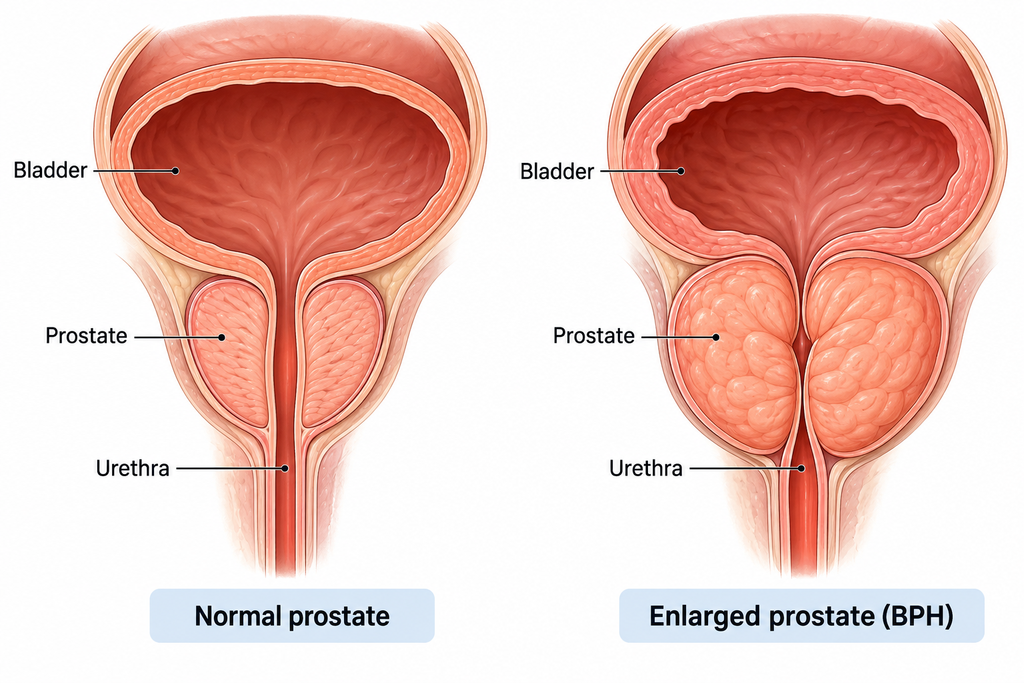
Why does BPH happen?
The prostate slowly grows throughout a man’s life because of age-related hormone changes. As it enlarges, it can squeeze the urethra, the tube that carries urine out of the body, making it harder for the bladder to empty fully.
What tests may be done?
Your urologist may advise a symptom questionnaire (IPSS), a physical examination including a prostate check, a urine test, a kidney function test, an ultrasound, and a urine flow test. A PSA blood test may be offered after discussing its benefits and limits. PSA alone cannot confirm or rule out prostate cancer, so results are always interpreted together with the examination and other tests.
Tips that may ease symptoms
- Reduce fluids in the 2 hours before bedtime
- Cut down on tea, coffee and alcohol, especially in the evening
- Do not hold urine for very long periods
- Avoid constipation
- Stay active and keep a healthy weight
- Ask your doctor to review medicines that may worsen symptoms
These tips can help mild symptoms. Medicines and, when needed, procedures such as TURP or HoLEP work very well for more troublesome symptoms.
Frequently asked questions
Is waking up at night to pass urine normal?
Waking once a night can be normal, especially with age. Waking twice or more regularly is worth checking, as it may be due to BPH or other treatable causes.
Can BPH symptoms come and go?
Yes. Symptoms can vary from day to day and can worsen with cold weather, caffeine, alcohol or some medicines.
At what age should I get my prostate checked?
See a urologist at any age if you have urinary symptoms. Men aged 50 and above, or 45 and above with a family history of prostate cancer, can also discuss a PSA test with their doctor.
Can an enlarged prostate stop urine completely?
Yes, sometimes. This is called acute urinary retention and is a medical emergency. A catheter is usually needed to drain the bladder.
If you notice any BPH warning signs, see a urologist early rather than waiting for the problem to become severe.
This article is based on the European Association of Urology (EAU) Guidelines on Management of Non-neurogenic Male LUTS.
Read more: Enlarged prostate (BPH): symptoms, causes and treatment
Read more: BPH myths and facts