
Written and medically reviewed by Dr. Sudeep Singh, MCh (Urology), FEBU
Kidney stone myths are very common, and many of them can delay proper treatment. Here we separate kidney stone myths from facts and answer the questions patients ask most often.
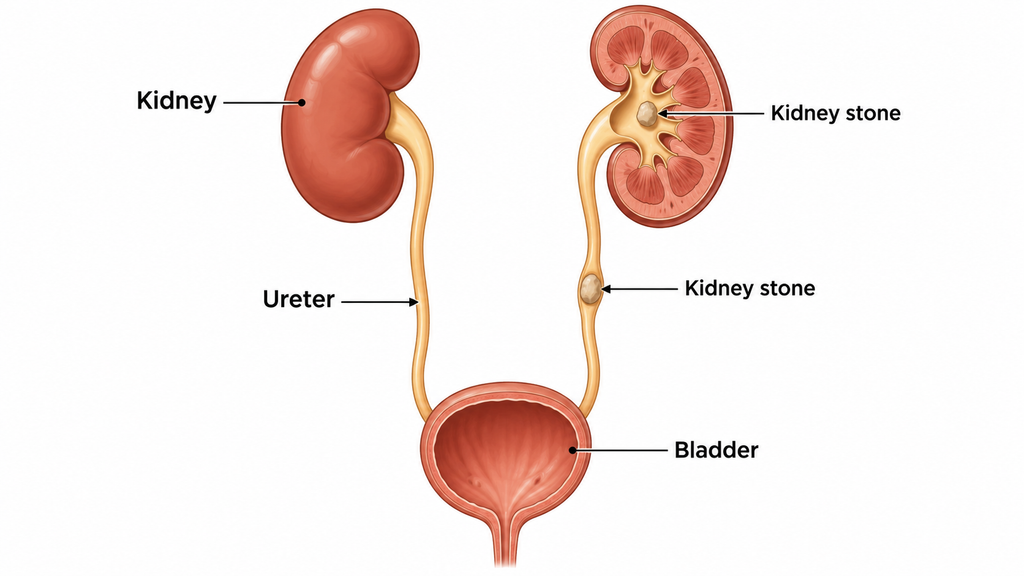
Table of Contents
Kidney stone myths vs facts
Myth: Hard water is the main cause of kidney stones.
Fact: Low water intake and diet matter far more than water hardness. The safest habit is simply drinking more water, whatever its source.
Myth: A painless stone isn’t a problem.
Fact: A silent stone can still block urine flow and damage the kidney over time. This is why regular monitoring matters, even without pain.
Myth: Once removed, a stone never comes back.
Fact: Close to half of patients develop another stone within five to ten years without preventive steps. Prevention matters as much as treatment.
Myth: Every kidney stone needs surgery.
Fact: Many small stones pass on their own with fluids and medication. Procedures are generally advised for larger stones, stones that do not pass, or stones causing blockage, infection or persistent pain.
Myth: If you have kidney stones, you should avoid calcium completely.
Fact: Cutting out dietary calcium can actually raise stone risk, because calcium binds oxalate in the gut before it reaches the kidneys. Calcium from food is usually fine. Calcium supplements need more caution and are best taken under medical guidance.
Myth: Only men get kidney stones.
Fact: Kidney stones affect both men and women. Men have historically had higher rates, but the gap has been narrowing with changing diets and lifestyles.
Myth: You’ll always know if you have a kidney stone.
Fact: Many small stones cause no symptoms and are found by chance during a scan done for something else.
Questions patients often ask
Can lemon juice or apple cider vinegar dissolve a stone?
There is no reliable evidence that home remedies dissolve stones. They should not replace a proper medical evaluation, especially if you have pain or a larger stone. One exception is uric acid stones, which can sometimes be dissolved with medicines prescribed by your doctor.
Is kidney stone surgery very painful?
Modern procedures such as laser treatment (URS, RIRS) and PCNL are done under anaesthesia, through small or no incisions. Some discomfort afterwards is normal and is usually controlled with pain medicines. If a temporary stent (a thin tube between the kidney and bladder) is placed, it can cause some urgency or discomfort until it is removed.
How soon can I go back to work?
This depends on the procedure. After URS or RIRS, many people return to light activity within a few days. Recovery after PCNL usually takes longer, often one to two weeks. Your doctor will guide you based on your procedure and job.
What is RIRS, and how is it different from other laser treatment?
RIRS (Retrograde Intrarenal Surgery) uses a thin, flexible telescope passed through the natural urinary passage to reach stones inside the kidney itself, not just in the ureter. No skin cuts are made, and the hospital stay is usually short. It is one of the standard options for many kidney stones up to about 2 cm.
Can kidney stones lead to kidney failure if left untreated?
A single small stone rarely causes lasting damage. However, a stone that blocks urine flow for a long time, or repeated untreated stones, can gradually harm kidney function. Persistent pain or symptoms should not be ignored.
Are kidney stones hereditary?
Family history matters. Having a parent or sibling with kidney stones roughly doubles your own risk, so mention it during your consultation.
Is major or robotic surgery ever needed for kidney stones?
Rarely. Most stones are treated with ESWL, ureteroscopy, RIRS or PCNL. Open, laparoscopic or robotic surgery is reserved for very large, complex or unusual cases.
If you have heard other kidney stone myths and are unsure what to believe, discuss them with your urologist before trying any remedy. Clearing up kidney stone myths early can prevent delays in proper treatment.
This article is based on the European Association of Urology (EAU) Guidelines on Urolithiasis.
Read more
For a complete overview of symptoms, tests and treatment, read our guide: Kidney Stones: Symptoms, Causes and Treatment Options.
This article is for general information only and does not replace a consultation with a qualified doctor.