
Kidney stone warning signs are easy to miss at first. The pain often starts as a dull ache in the back or side that feels like a pulled muscle, and can become severe within hours. Knowing the kidney stone warning signs helps you get the right care at the right time.
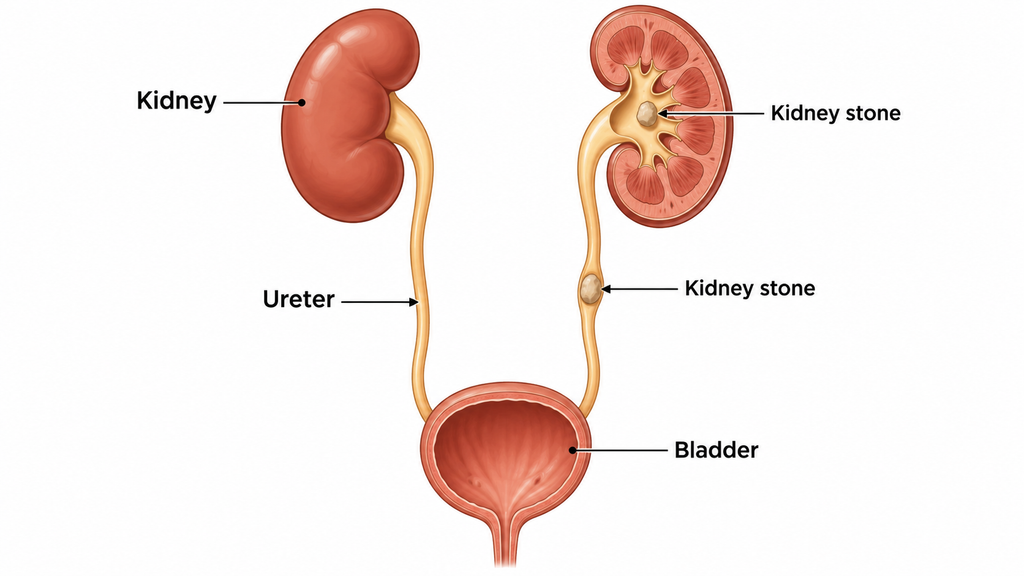
Table of Contents
What is a kidney stone?
A kidney stone is a hard deposit of minerals that forms inside the kidney when urine becomes too concentrated. Small stones may pass on their own. Larger stones can get stuck in the ureter, the thin tube that carries urine from the kidney to the bladder, and this is usually when symptoms begin.
Kidney stones are common. Around 1 in 10 people will have one at some point in their life, and they are increasingly seen in younger adults.
7 kidney stone warning signs
- Severe pain in the back or side, just below the ribs. It often comes in waves, and it can be hard to find a comfortable position. Doctors call this renal colic.
- Pain spreading to the lower abdomen or groin as the stone moves down.
- Blood in the urine. Urine may look pink, red or brown. Sometimes the blood is only seen on a urine test.
- Nausea and vomiting, which often come with the pain.
- Burning or pain while passing urine.
- Needing to pass urine often or urgently, especially when the stone is close to the bladder.
- Fever and chills, which can mean infection.
Some stones cause no symptoms at all and are found on a scan done for another reason.
When is it an emergency?
Go to the nearest emergency department straight away if you have stone pain along with any of these:
- Fever, chills or shivering. An infected, blocked kidney is a medical emergency and may need urgent drainage.
- Pain that is not controlled by painkillers.
- Vomiting so much that you cannot keep fluids down.
- Passing very little or no urine.
- Only one kidney, a kidney transplant, or pregnancy.
Other conditions can cause similar pain, such as appendicitis, gallstones, urine infection or muscle strain, and in women, some pregnancy or ovarian problems. This is why it is important to be examined rather than guess the cause.
Why do kidney stones form?
The most common reasons are:
- Not drinking enough water, especially in hot weather when we sweat more
- A diet high in salt or animal protein
- Being overweight, or having diabetes
- A family history of kidney stones
- Some medical conditions and medicines
How are kidney stones diagnosed?
Your doctor will usually ask for a urine test and blood tests to check kidney function and look for infection. An ultrasound is often the first scan. A non-contrast CT scan is the most accurate test for finding stones and measuring their size.
Treatment options
Treatment depends on the size and position of the stone, your symptoms, whether there is infection, and how well your kidneys are working.
- Small stones often pass on their own with water, painkillers and sometimes a medicine that relaxes the ureter.
- Shock wave lithotripsy (ESWL) breaks stones from outside the body.
- Ureteroscopy (URS) and RIRS use a thin telescope passed through the natural urinary passage, with no cut on the skin, to break and remove stones with a laser.
- PCNL removes larger kidney stones through a small keyhole in the back.
A small temporary tube called a stent may sometimes be placed after treatment. Your urologist will explain which option suits your situation.
How to prevent kidney stones
- Drink enough water to pass about 2 to 2.5 litres of urine a day. For most people this means 2.5 to 3 litres of fluid, and more in summer. If you have heart or kidney disease, ask your doctor how much to drink.
- Reduce salt in your diet.
- Keep animal protein moderate.
- Do not cut out calcium. Normal amounts of calcium from food actually help prevent the most common type of stone.
- Stay active and keep a healthy weight.
- If you have had a stone before, stone analysis and urine tests can help plan prevention for you.
Frequently asked questions
Can kidney stone pain come and go?
Yes. Stone pain often comes in waves as the ureter squeezes to push the stone down. Pain that settles does not always mean the stone has passed, so follow-up is important.
Can a kidney stone cause fever?
A stone on its own does not usually cause fever. Fever with stone pain can mean infection behind a blocked kidney, which needs urgent medical care.
How long does a small kidney stone take to pass?
Many small stones pass within a few weeks. If a stone has not passed after about 4 to 6 weeks, or symptoms get worse, see your urologist.
Does every kidney stone need surgery?
No. Many small stones pass on their own. Treatment is needed when a stone is large, causes ongoing pain or infection, or blocks the flow of urine.
If you notice any kidney stone warning signs, see a doctor early rather than waiting for the pain to become severe.
This article is based on the European Association of Urology (EAU) Guidelines on Urolithiasis.
Read more: Kidney stones: symptoms, causes and treatment options
Read more: 7 kidney stone myths and facts