
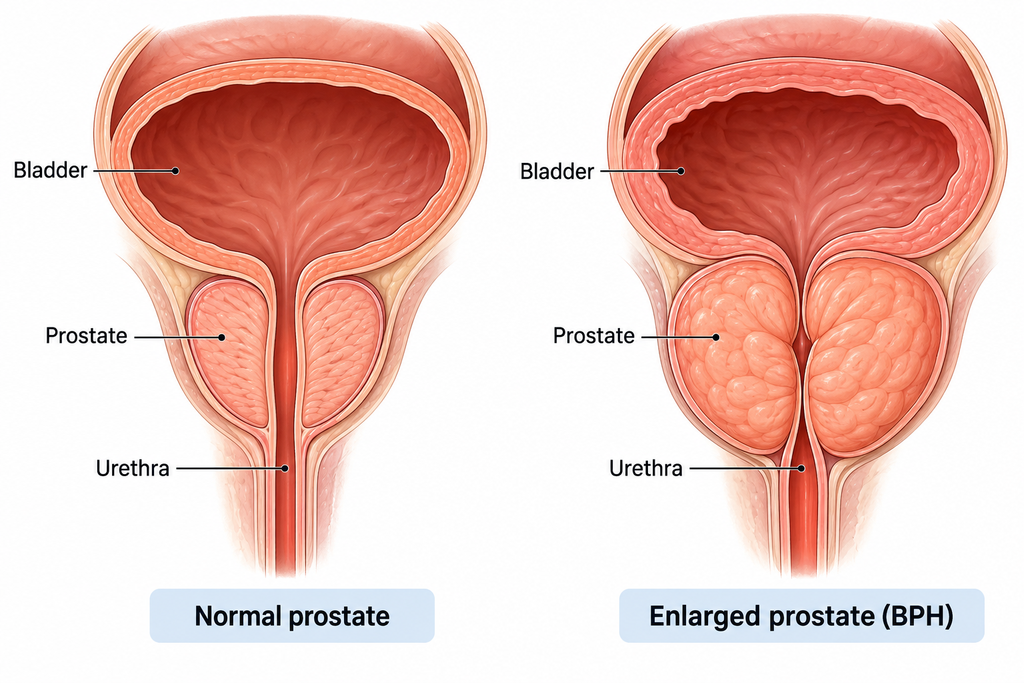
TURP surgery (transurethral resection of the prostate) is one of the most established and widely performed operations for an enlarged prostate, also called benign prostatic hyperplasia (BPH). It removes the part of the prostate that blocks urine flow, through the urine passage, with no cuts on the skin.
Table of Contents
What is TURP surgery?
In TURP, a thin telescope called a resectoscope is passed through the urethra (the urine passage). A small electric wire loop is used to shave away the enlarged inner part of the prostate in small pieces. These pieces are washed out of the bladder and sent for laboratory testing. The surgeon also seals bleeding points during the procedure.
TURP has been used for decades and is still a standard treatment for small to medium-sized prostates in the European Association of Urology (EAU) guidelines.
Monopolar and bipolar TURP
There are two main types of TURP:
- Monopolar TURP, the traditional method
- Bipolar TURP, a newer method that uses saline (salt water) as the washing fluid
Both improve urine flow equally well. Bipolar TURP lowers the risk of a rare complication called TUR syndrome, where too much washing fluid is absorbed into the body, and it may cause less bleeding.
Who may need TURP?
TURP may be advised if you have:
- Bothersome urinary symptoms that have not improved enough with medicines
- Episodes of being unable to pass urine (urinary retention), or a catheter in place
- Repeated urine infections or bleeding caused by the prostate
- Bladder stones due to poor bladder emptying
- Kidney strain caused by the blockage
TURP is best suited to prostates of small to medium size. For very large prostates, HoLEP laser prostate surgery is often preferred.
How is TURP performed?
- The surgery is done under spinal or general anaesthesia.
- It usually takes about 1 hour.
- A resectoscope is passed through the urethra. There are no cuts on the skin.
- At the end, a urinary catheter is placed, often with a gentle fluid wash to prevent clots.
Before TURP surgery
You will usually have:
- Blood tests, a urine test and an ultrasound
- A PSA test and prostate assessment where appropriate
- A heart check and anaesthesia review
- A plan for stopping or adjusting blood thinners and diabetes medicines
Tell your doctor about every medicine you take, especially blood thinners.
Recovery after TURP
- Most patients stay in hospital for 2 to 3 days.
- The catheter is usually removed after 2 to 3 days.
- Burning, frequency and urgency are common for a few weeks while the area heals.
- Some blood in the urine can come and go for up to 3 to 4 weeks, especially around 10 to 14 days after surgery. Drink plenty of water unless advised otherwise.
- Most men return to light activities within 1 to 2 weeks.
- Avoid heavy lifting, straining, cycling and strenuous exercise for about 4 to 6 weeks.
- Avoid constipation, as straining can cause bleeding.
Possible side effects and risks
- Dry ejaculation (retrograde ejaculation): common after TURP. Semen goes back into the bladder instead of coming out. It is not harmful, but it affects fertility.
- Bleeding, which occasionally needs a longer catheter time or a return to theatre
- Urine infection
- Temporary leakage of urine, which usually improves within weeks
- Narrowing of the urethra or bladder neck, which may need treatment later
- TUR syndrome, which is rare, especially with bipolar TURP
- Need for repeat treatment after some years, as the remaining prostate can grow again
- Erections: usually unchanged
When to contact your doctor after TURP
Seek medical help urgently if you:
- Cannot pass urine
- Have heavy bleeding or clots
- Develop fever or shivering
- Have severe pain that does not settle
Frequently asked questions
Is TURP a major operation?
TURP is done through the urine passage without cuts, so it is less invasive than open surgery. It is still a surgical procedure under anaesthesia, and your fitness will be checked beforehand.
TURP or HoLEP: which is better?
Both work well. TURP is a good option for small to medium prostates. HoLEP is often preferred for larger prostates, for patients on blood thinners, and when a lower chance of repeat surgery is a priority. Your urologist will advise based on your prostate size and health.
Will TURP affect my sex life?
Erections are usually not affected. Most men have dry ejaculation afterwards. If you plan to have children, discuss this with your urologist before surgery.
Can the prostate grow back after TURP?
Some prostate tissue remains, so it can grow again over the years. A small number of men need repeat treatment later.
Why is there blood in my urine two weeks after TURP?
Around 10 to 14 days after surgery, small scabs inside the prostate can come off and cause some bleeding. Drinking extra water usually settles it. If bleeding is heavy or you cannot pass urine, seek medical help.
If you have an enlarged prostate and medicines are no longer helping, ask your urologist whether TURP surgery is right for you.
This article is based on the European Association of Urology (EAU) Guidelines on Management of Non-neurogenic Male LUTS.
Read more: Enlarged prostate (BPH): symptoms, causes and treatment
Read more: HoLEP laser prostate surgery
Read more: BPH warning signs