

Seeing blood in your urine can be frightening. Sometimes the cause is simple, like an infection or a kidney stone. Sometimes it is the first sign of something more serious, such as a bladder or kidney tumour. That is why blood in urine should always be checked by a doctor, even if it happens only once and even if there is no pain.
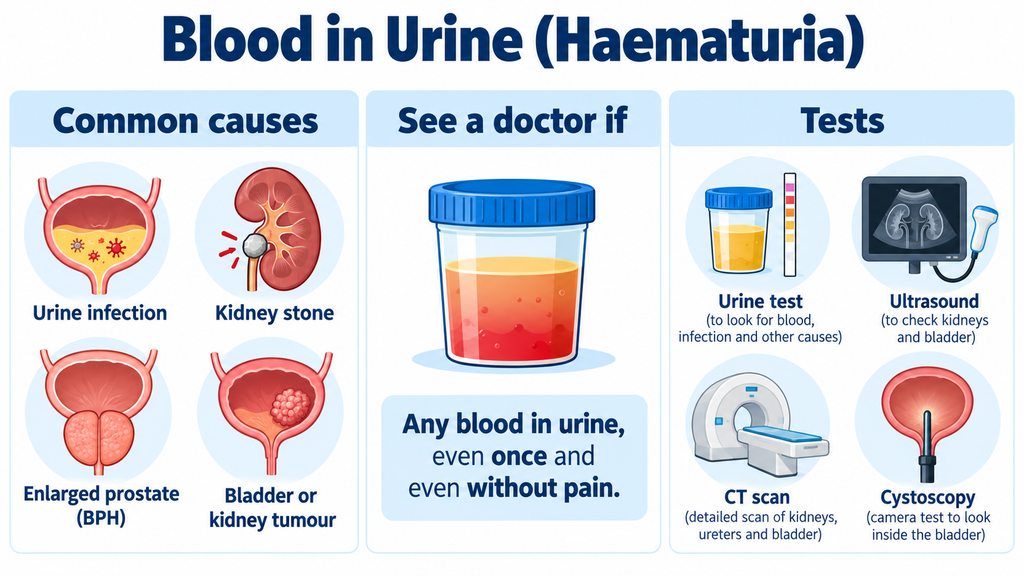
Table of Contents
What is haematuria?
Haematuria is the medical word for blood in the urine. There are two types:
- Visible (gross) haematuria: you can see it. Urine may look pink, red, brown or cola-coloured, and may contain clots.
- Microscopic haematuria: the urine looks normal, but red blood cells are found when it is tested in a laboratory, often during a routine health check.
Both types need attention. Visible blood carries a higher chance of a serious cause, so it should be investigated promptly.
Is it really blood?
Some foods and medicines can turn urine red or orange without any blood in it. Common examples are beetroot, certain berries, food colours, and medicines such as rifampicin (used for TB) and phenazopyridine. Very concentrated urine from dehydration can also look dark. A simple urine test tells your doctor whether real blood is present.
Common causes of blood in urine
- Urine infection (UTI): usually with burning, frequent urination or fever.
- Kidney and ureter stones: often with severe pain in the side, back or groin.
- Enlarged prostate (BPH): in men over 50, fragile blood vessels on the prostate can bleed.
- Bladder cancer: often painless. Smoking is the biggest risk factor.
- Kidney cancer: may cause painless blood, a side mass or side pain.
- Kidney diseases (glomerulonephritis): may come with swelling, high blood pressure or protein in the urine.
- Recent injury, catheter or urological procedure.
- Vigorous exercise: can cause short-lived blood in urine, but this is diagnosed only after other causes are ruled out.
Blood thinners such as aspirin, clopidogrel or warfarin can make bleeding more likely, but they do not explain it away. People on blood thinners still need full tests.
Who is at higher risk of a serious cause?
Your doctor will take extra care if you:
- Are over 40 years of age
- Smoke now or smoked in the past
- Have had visible blood in the urine
- Have worked with dyes, rubber, leather or industrial chemicals
- Have had pelvic radiotherapy or certain chemotherapy medicines
When to seek urgent care
Go to the emergency department straight away if you have:
- Blood clots and you cannot pass urine
- Heavy bleeding, dizziness or fainting
- Blood in urine with high fever and shivering
- Severe pain that does not settle with painkillers
How is blood in urine investigated?
Tests depend on your age, symptoms and risk factors. They may include:
- Urine tests: urine routine and microscopy, urine culture, and sometimes urine cytology to look for abnormal cells.
- Blood tests: kidney function (creatinine) and blood count.
- Ultrasound of the kidneys and bladder.
- CT urography: a detailed CT scan of the kidneys, ureters and bladder, usually advised for visible blood or higher-risk patients.
- Cystoscopy: a thin telescope passed through the urethra to look directly inside the bladder. It is usually done under local anaesthetic jelly and takes a few minutes.
These tests follow international guidance such as the European Association of Urology (EAU) Guidelines on Non-muscle-invasive Bladder Cancer.
Treatment
Treatment depends on the cause. Infections are treated with antibiotics. Stones may pass on their own or need treatment such as RIRS or PCNL. Prostate bleeding may be treated with medicines or surgery. Tumours are treated according to their type and stage. Your urologist will explain the options that suit your situation.
Can blood in urine go away on its own?
Yes, the bleeding can stop on its own, even when the cause is serious. Bladder tumours often bleed on and off. Stopping does not mean the problem has gone, so tests are still needed.
Frequently asked questions
Is blood in urine always cancer?
No. Most people turn out to have a less serious cause such as an infection or stone. But because cancer is possible, especially in smokers and people over 40, it should always be checked.
Should I stop my blood thinner if I see blood in my urine?
Do not stop it on your own. Some blood thinners protect you from stroke or heart attack. Speak to your doctor first.
Can a woman have blood in urine during periods?
Yes, period blood can mix with a urine sample. Repeat the test after your period finishes.
Which doctor should I see for blood in urine?
A urologist is the specialist for haematuria. Your family doctor can do the first urine test and refer you.
Where can I get blood in urine checked in Panchkula?
Dr. Sudeep Singh, Consultant Urologist, sees patients with blood in urine at Indus Super Speciality Hospital, Sector 15, Panchkula. The OPD runs Monday to Saturday, 9 AM to 5 PM. Ultrasound, CT scan and cystoscopy can be arranged at the hospital. For appointments, call +91-98156-55532.
Is cystoscopy available in the Chandigarh tricity?
Yes. Cystoscopy is available at major hospitals in Chandigarh, Mohali and Panchkula, including Indus Super Speciality Hospital, Panchkula. It is usually a short daycare procedure.
Related reading
Book a consultation
If you have noticed blood in your urine, see a urologist for an evaluation. Dr. Sudeep Singh, Consultant Urologist, sees patients at Indus Super Speciality Hospital, Sector 15, Panchkula. Call +91-98156-55532 for an appointment.
This article is for general information and does not replace a consultation with a doctor.