

Do you feel a sudden, strong urge to pass urine that is hard to hold back? Do you go to the toilet many times a day, or wake up several times at night to urinate? These are common signs of overactive bladder (OAB). It affects both men and women, becomes more common with age, and is often treatable. Yet many people suffer quietly, thinking it is a normal part of getting older.
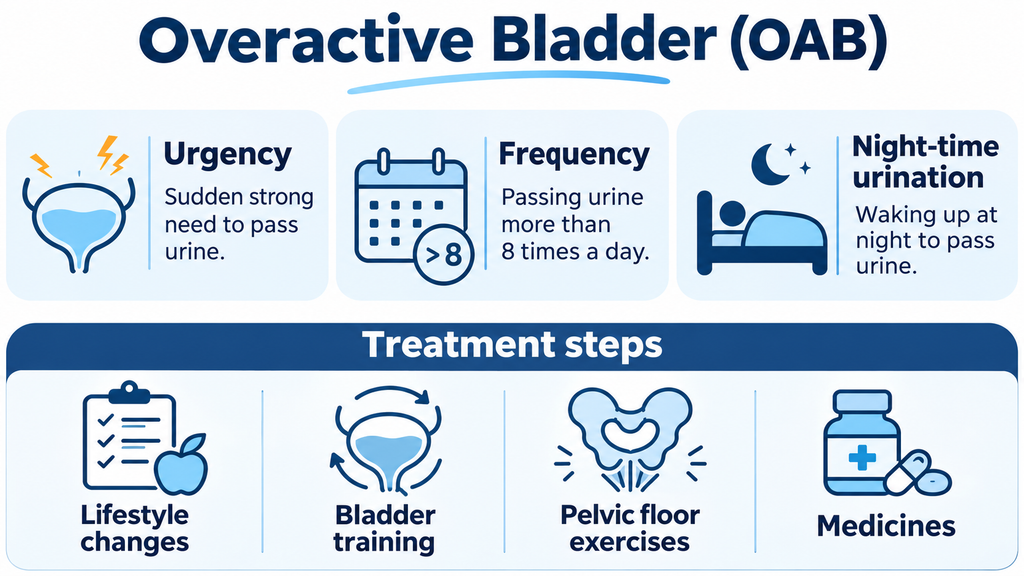
Table of Contents
What is overactive bladder?
Overactive bladder is a condition where the bladder muscle squeezes suddenly, even when the bladder is not full. This causes:
- Urgency: a sudden, strong need to pass urine that is difficult to delay. This is the main symptom.
- Frequency: passing urine more often than usual, often more than 8 times in 24 hours.
- Nocturia: waking up at night one or more times to urinate.
- Urgency incontinence: leaking urine before reaching the toilet. Not everyone with OAB has leakage.
Doctors diagnose OAB only after ruling out other causes such as a urine infection.
What causes overactive bladder?
Often no single cause is found. Factors that can trigger or worsen OAB include:
- Ageing and weakening of the pelvic floor muscles
- Too much tea, coffee, cola, energy drinks or alcohol
- Drinking large amounts of fluid, especially in the evening
- Constipation
- Being overweight
- An enlarged prostate in men
- Menopause in women
- Diabetes
- Nerve conditions such as stroke, Parkinson’s disease, multiple sclerosis or spinal problems
Conditions that can look like overactive bladder
Some conditions cause similar symptoms and need different treatment:
- Urine infection (UTI)
- Enlarged prostate (BPH)
- Bladder stones
- Bladder cancer, especially if there is blood in the urine
- Diabetes, which can cause passing large amounts of urine
That is why it is important to see a doctor rather than treating yourself.
When to see a doctor straight away
Seek medical advice promptly if urinary symptoms come with:
- Blood in the urine
- Pain or burning while passing urine, or fever
- Difficulty passing urine or a feeling that the bladder does not empty
- Weakness or numbness in the legs, or new back pain
- Repeated urine infections
How is overactive bladder diagnosed?
Your doctor will ask about your symptoms and examine you. Tests may include:
- Urine test to look for infection, blood or sugar.
- Bladder diary: you record how much you drink, how often you pass urine and any leakage for 3 days. This is one of the most useful tests.
- Ultrasound of the kidneys and bladder, including how much urine is left after passing urine.
- Urine flow test (uroflowmetry), especially in men.
- Urodynamic study: a detailed bladder pressure test, needed only in selected patients, for example when first treatments have not helped or before surgery.
Treatment for overactive bladder
Treatment usually starts with simple steps and moves on only if needed.
1. Lifestyle changes
- Cut down on tea, coffee, cola and alcohol
- Drink a sensible amount of fluid, and less in the 2 to 3 hours before bed, unless your doctor advises otherwise
- Treat constipation
- Lose weight if you are overweight
- Stop smoking
2. Bladder training
Bladder training teaches the bladder to hold more urine. You gradually increase the time between toilet visits, using urge-control techniques when the urge comes. It takes several weeks, but many people improve with it.
3. Pelvic floor exercises
Regular pelvic floor muscle exercises strengthen the muscles that help control urine. They are especially helpful for women with leakage.
4. Medicines
If lifestyle changes and bladder training are not enough, medicines can relax the bladder muscle:
- Antimuscarinic medicines such as solifenacin, tolterodine, trospium and oxybutynin. Side effects can include dry mouth and constipation. In older people, some of these medicines may affect memory, so the choice needs care.
- Beta-3 agonists such as mirabegron and vibegron. They work differently and do not usually cause dry mouth. Blood pressure may need checking.
5. Treatments when medicines do not help
For people whose symptoms remain troublesome despite medicines, options include:
- Botulinum toxin (Botox) injections into the bladder through a thin telescope
- Nerve stimulation treatments, such as tibial nerve stimulation or sacral neuromodulation
Your urologist will explain which option suits you, along with its benefits and possible side effects.
These steps follow the European Association of Urology (EAU) Guidelines on Non-neurogenic Female LUTS and the EAU guidance on male lower urinary tract symptoms.
Overactive bladder in men
In men, urgency and frequency are often linked with an enlarged prostate. Treatment may need to address both the prostate and the bladder. Read more about warning signs of an enlarged prostate.
Frequently asked questions
Is overactive bladder a normal part of ageing?
No. It is more common with age, but it is a medical condition and often improves with treatment.
Will drinking less water cure overactive bladder?
Drinking too little can make urine concentrated, which may irritate the bladder and cause constipation or kidney stones. The aim is a sensible amount, not as little as possible.
How long does treatment take to work?
Bladder training and pelvic floor exercises usually take 6 to 12 weeks. Medicines are usually reviewed after about 4 to 8 weeks.
Is baar baar peshab aana (frequent urination) always overactive bladder?
No. Frequent urination can also be caused by urine infection, diabetes, an enlarged prostate or bladder stones. A urine test and examination help find the cause.
Where can I get treatment for overactive bladder in Panchkula?
Dr. Sudeep Singh, Consultant Urologist and Andrologist, sees patients at Indus Super Speciality Hospital, Sector 15, Panchkula (Monday to Saturday, 9 AM to 5 PM) and Malhotra Hospital & Orthopaedic Centre, Sector 7, Panchkula (Monday to Saturday, 5 to 6:30 PM). Call +91-98156-55532 for an appointment.
Related reading
This article is for general information and does not replace a consultation with a doctor.