
A PSA test is a simple blood test that helps check the health of the prostate. Many men get worried when they see a “high PSA” on their report. A raised PSA does not always mean cancer. This guide explains what the PSA test is, what the results mean, and what happens next.
Table of Contents
What is a PSA test?
PSA stands for prostate-specific antigen. It is a protein made by the prostate gland, and small amounts normally pass into the blood. The PSA test measures this level in nanograms per millilitre (ng/ml).
PSA can rise because of prostate cancer, but also because of common non-cancerous conditions. That is why PSA is a guide, not a diagnosis.
What is a normal PSA level?
There is no single “normal” PSA for every man. PSA naturally rises with age and prostate size. Many laboratories use 4 ng/ml as a cut-off, but:
- A PSA below 4 does not completely rule out prostate cancer.
- A PSA above 4 does not mean you have cancer. Most men with a mildly raised PSA do not have cancer.
Your urologist will interpret your PSA along with your age, prostate size, examination, family history and any previous PSA results. A rising trend over time can matter more than a single number.
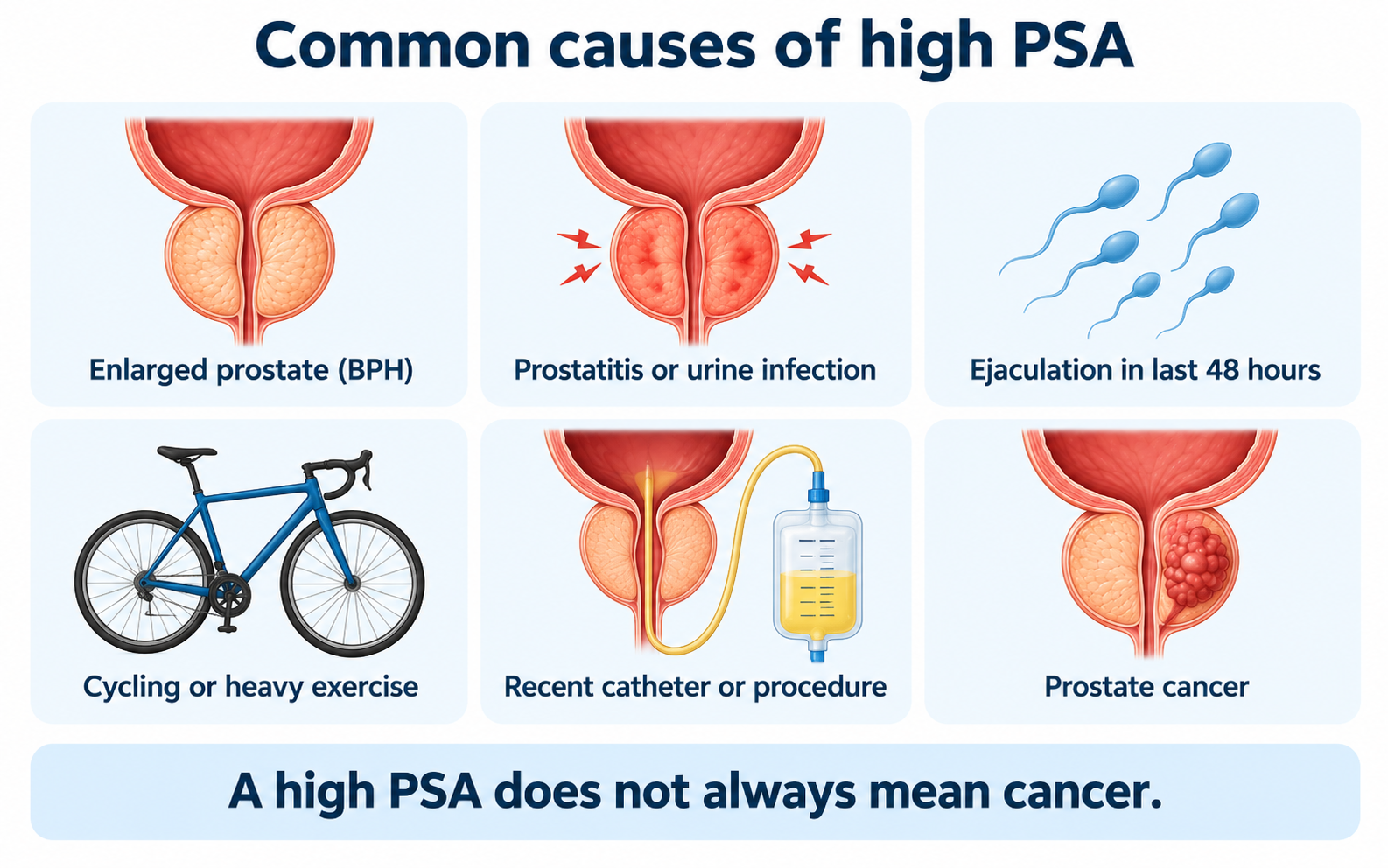
Causes of high PSA other than cancer
- Enlarged prostate (BPH), the most common cause
- Prostatitis or a urine infection
- Ejaculation in the previous 48 hours
- Vigorous exercise or cycling in the previous 48 hours
- A recent catheter, cystoscopy or prostate biopsy
- Urinary retention, when the bladder cannot empty
Some medicines lower PSA. Finasteride and dutasteride, used for BPH and hair loss, reduce PSA by about half. Always tell your doctor if you take them.
How to prepare for a PSA test
- Avoid ejaculation for 48 hours before the test.
- Avoid cycling and strenuous exercise for 48 hours.
- If you have a urine infection, wait until it has been treated and settled, usually about 6 weeks, before testing.
- Tell your doctor about recent catheters, procedures and medicines.
Fasting is not needed.
Who should have a PSA test?
The European Association of Urology (EAU) advises that PSA testing should be offered after discussing its benefits and limits, rather than done routinely without discussion. It may be offered to men:
- Aged 50 and above
- Aged 45 and above with a family history of prostate cancer
- Aged 40 and above who carry a BRCA2 gene change
See a urologist at any age if you have urinary symptoms, blood in the urine or semen, or bone pain.
Benefits and limits of PSA testing
Benefits:
- Can detect prostate cancer early, when treatment is most effective
- Helps decide who needs further tests
Limits:
- Can be raised without cancer, causing worry and extra tests
- Can occasionally be normal even when cancer is present
- Can detect slow-growing cancers that may never cause harm, which may lead to treatment that was not needed
This is why it is best decided together with your doctor.
What happens if my PSA is high?
A single high PSA is not a reason to panic. Your urologist may:
- Repeat the test after a few weeks, sometimes after treating an infection
- Examine the prostate (digital rectal examination)
- Check PSA density (PSA compared with prostate size) or free PSA
- Advise an MRI scan of the prostate, which helps decide whether a biopsy is needed and guides it to the right area
- Advise a prostate biopsy only if the tests suggest it is needed
Many men with a raised PSA do not need a biopsy after these steps.
Frequently asked questions
Does a high PSA mean I have prostate cancer?
No. BPH, infection and recent ejaculation are common causes. Further tests, such as a repeat PSA and an MRI scan, help find the cause.
How often should I have a PSA test?
It depends on your age, your PSA level and your risk factors. Men with a very low PSA may need testing less often. Your urologist will advise how often to repeat it.
Can BPH increase PSA?
Yes. An enlarged prostate makes more PSA, so PSA often rises with prostate size. BPH does not turn into cancer.
Do I need to fast before a PSA test?
No. Fasting is not needed. Avoid ejaculation, cycling and strenuous exercise for 48 hours beforehand.
Can a PSA test be wrong?
PSA can be raised for reasons other than cancer and can occasionally be normal when cancer is present. That is why results are always interpreted together with other tests.
If your PSA report is high, don’t panic and don’t ignore it. See a urologist, who can explain what your PSA test result means for you.
This article is based on the European Association of Urology (EAU) Guidelines on Prostate Cancer.
Read more: Enlarged prostate (BPH): symptoms, causes and treatment
Read more: BPH myths and facts
Read more: BPH warning signs